
 Open in Claude
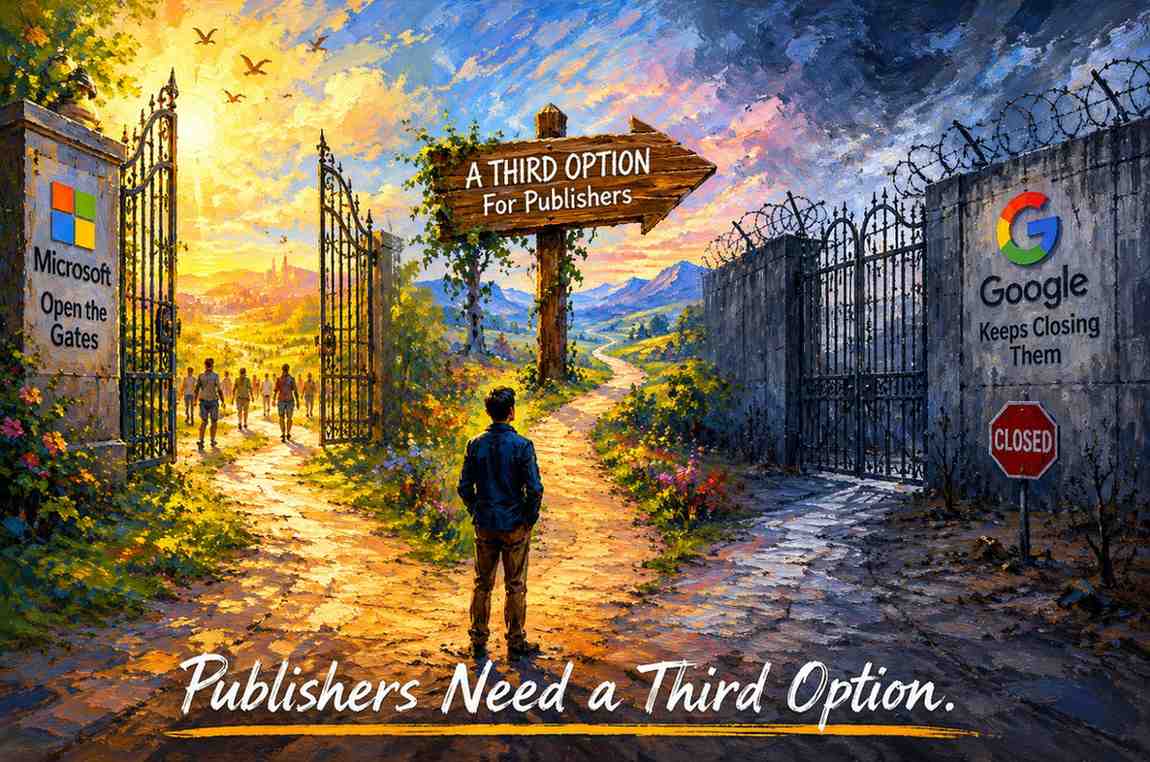
Two stories landed in the same week of May 2026 and they tell one story. Microsoft's Nikhil Kolar took the Programmatic AI stage in Las Vegas and told publishers to stop blocking AI crawlers. Google announced its biggest Search overhaul in 25 years, pushing AI Mode deeper into the default surface where blue links used to live. The first side wants publisher content in. The second side has already decoupled that content from the traffic that paid for it. Both sides are correct about the future. Neither is offering the payment rail it needs.
- AI Overviews now correlate with a 58% drop in click-through rate for top-ranking pages, per Ahrefs' February 2026 study of 300,000 keywords — nearly double the 34.5% decline measured a year earlier.
- AI crawlers take roughly 20,000 pages from Anthropic's ClaudeBot for every one referral returned, and over 1,200 from OpenAI's GPTBot, according to Cloudflare Radar Q1 2026 data.
- Microsoft's Publisher Content Marketplace, launched 3 February 2026 with the AP, Vox Media, USA Today, Condé Nast, Hearst, and People Inc, prices grounding — not the ad layer that sits on top of it.
- The shift from link economy to citation economy is now structural. What is missing is a market for sponsored citations, priced and cleared, that pays both sides.
What the citation economy actually is
The citation economy is the value chain in which AI Search engines extract, synthesize, and cite publisher content to answer user queries, and in which brand visibility and publisher revenue are tied to being cited inside that answer rather than ranked above it. The unit of value moves from click to citation. The unit of cost moves from CPC to per-grounding fee. The unit of attribution moves from referral header to citation share.
For 25 years the open web ran on a simple loop: publishers produced, Google indexed, users clicked, advertisers paid. That loop is closing. The new loop is publishers produce, engines ground, agents answer, users do not need to click. Microsoft's PCM prices the second step. Google's AI Mode is collapsing the fourth. The third and fifth steps — the ad inside the answer, and the compensation for being the source of record — remain unpriced.
The link economy and the citation economy, running in parallel
In the link economy, attention was rented per click on a SERP. Publishers monetized the click, brands paid for ranking, Google brokered the auction. In the citation economy, attention is allocated per citation inside a synthesized answer. Publishers fund the grounding, brands need to be inside the answer, and no clearing house exists yet for the value transfer. The mechanism is different. The underlying need has not changed: brands still need to be seen, publishers still need to be paid for being the source.
Cloudflare data quantifies the asymmetry. As of January 2026, Google still controls 91.2% of search engine referrals and 81.6% of all web referrals. But the engines feeding the new answer surface return almost nothing: ClaudeBot's crawl-to-refer ratio sits at roughly 20,583 to 1; OpenAI's at 1,255 to 1; Meta sends zero referrals. The asymmetry is not a bug of an early system. It is the system.
What Microsoft, Press Gazette, and TechRepublic each saw — and what we verified
Microsoft's Kolar told AdExchanger that four out of five sites currently block AI bots, framing this as commercial self-harm. Independent data tells a more selective story: a Q1 2026 Cloudflare Radar analysis paired with a BuzzStream survey found 79% of top news sites block AI training bots specifically, while only 14% of publishers block all AI bots completely. The blanket figure flattens a deliberate, selective stance — publishers are blocking the takers, not closing the door.
Press Gazette reported on 26 May 2026 that Google AI Mode will not yet be the default Search experience — what SEO consultant Lily Ray called a 'small sigh of relief' — but warned the new features 'will absolutely continue to cut into organic traffic across the board.' TechRepublic's coverage of the same I/O announcement framed the upgrade as the conversationalization of the Search box, powered by Gemini 3.5 Flash, with agentic capabilities layered in. Google itself called it the biggest Search upgrade in over 25 years. Treat that phrasing as binding: the company is conceding the inflection.
Why open-the-gates and lock-the-gates are both insufficient strategies
The strongest version of the Microsoft case
Microsoft's argument deserves the steelman. Kolar is right that content invisible to agents is content removed from the next decade of discovery. The Publisher Content Marketplace, launched 3 February 2026 with seven blue-chip partners, prices grounding usage rather than one-off lump sums — a structural improvement on the bespoke deals signed in 2023 to 2025. People Inc's Jonathan Roberts confirmed at Programmatic AI 2026 that Microsoft has since grown the roster to eight publishers, with the stated ambition of signing the entire open web. Amazon Web Services is reportedly building a parallel marketplace. The licensing rail is being built in real time.
Why a licensing rail without an ad layer is half a market
Licensing solves one half of the value chain — the cost side for AI builders. It does not solve the demand side, where brands need to be visible inside the synthesized answer itself. A publisher paid for grounding still sees its audience served an answer with no commercial real estate, no sponsored placement, no transparent attribution back to the source brand. That is not a payment rail. It is a wholesale tariff with no retail market on top.
The selective blocking that Roberts described — People Inc permits 38 crawlers and refuses tens of thousands daily — is rational negotiating posture for top-tier publishers. It is not a viable strategy for the long tail of mid-market sites that lack the leverage to be the next PCM signatory. Without a market mechanism that compensates citation at scale, the gap between top-tier negotiated deals and everyone else widens into a chasm. The market needs an ad layer to clear, not just a content tariff to license.
What this means for brands and for publishers
For CMOs, media buyers, agencies, and SEA leads: ringfence the AI-visibility line in 2026 budgets
Treat AI visibility as a discipline distinct from SEO and SEA, with its own budget, owner, and KPIs. CMOs should ringfence a 2026 test budget for emerging AI Search advertising inventory — native ads placed inside AI-generated answers rather than alongside blue links. Media buyers should audit what share of their funnel already depends on AI Search referrals versus classic organic. Agencies should build the AI visibility practice as a service line before clients ask why a competitor is being cited in ChatGPT, Perplexity, Copilot, or Google AI Mode and they are not. SEA leads should expect AI Mode to become default the moment Google figures out, in Lily Ray's words, how to monetize it at parity with organic search. Plan for that quarter — not for the announcement after it.
For publishers: stop pricing the future on traffic recovery, start pricing it on citation share
The honest read from the Press Gazette commentary is the one Steve Wilson-Beales offered: this announcement is one more nail in the coffin for publishers built on top-of-funnel head-term traffic. Stop pricing your future on traffic recovery. Price it on being the source of record that AI engines cite, and on the dual revenue stream that fits that role — usage-based licensing for grounding (what Microsoft's PCM is building) plus citation-based advertising for the answers themselves. The publishers that sign both rails compound an advantage. The ones that wait for blue-link CPMs to return are pricing for a market that is closing.
Three signals that decide where this lands within 18 months
Three signals tell you when the citation economy gets its clearing house. First: when a second large platform — Amazon's reported AWS marketplace, or Google itself — launches a usage-based licensing rail that interoperates with Microsoft's PCM, the licensing layer commodifies. Second: when AI engines publicly test sponsored placements inside answers (Lily Ray's prediction for the moment AI Mode goes default), the ad layer activates. Third: when at least one major publisher reports that combined licensing plus citation-ad revenue offsets a measurable portion of lost organic traffic, the model proves out. Watch Q1 to Q4 2027 for at least two of the three.
Conclusion
Hold on to this: the open-web link economy has structurally given way to an agentic-web citation economy, and the gap between the two is a missing ad layer that pays publishers for being the source and lets brands be visible inside the answer. Smalk AI is being built for exactly that gap — a next-generation ad network for the AI Search era that places native ads for AI agents inside generated answers and opens a new revenue stream for the publishers whose content fuels those answers. What to watch next: whether the first usage-based licensing rail (Microsoft PCM today, AWS and others to follow) interoperates with a sponsored-citation layer — that is the moment the citation economy stops being a thesis and starts pricing in.